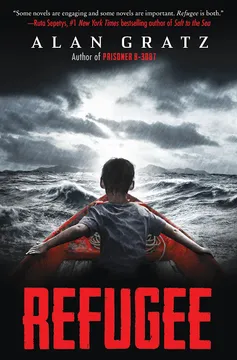
Refugee
Alan Gratz • Novel, Historical Fiction
Refugee by Alan Gratz Summary — Characters & Analysis
Refugee by Alan Gratz is a powerful historical fiction novel following three young refugees escaping danger in different eras. As a novel refugee, it explores the experiences of young people fleeing danger across different historical periods. This article includes a full summary, character descriptions, and analysis of the novel’s global significance.
Summary of Refugee
The book weaves together three stories, each following one of three refugee children as young protagonists on their journeys to safety. Josef flees Nazi Germany in the 1930s, Isabel escapes Cuba in 1994, and Mahmoud leaves Syria in 2015. Each storyline explores the unique challenges, dangers, and hopes faced by these young protagonists as they navigate perilous journeys in search of a better life.
The emotional depth of these intertwined stories leaves a lasting impact on readers, powerfully conveying the struggles and resilience of refugees across different times and places.
Josef — 1930s Germany
Josef's family, including Josef's father, Josef's mother, and Josef's sister, are Jewish refugees fleeing Nazi persecution and the urgent need to flee Germany due to rising violence. Along with other Jewish passengers aboard the ship MS St. Louis, they seek safety in Cuba. Josef's sister, Ruth, plays a significant role in the story, surviving the ordeal and later helping other refugees. Their journey reveals the rising terror under Hitler and the desperation of families trying to escape.
Isabel — 1994 Cuba
Facing political unrest and famine under Fidel Castro's regime, Isabel and her family are fleeing Cuba in a small boat. Isabel worries about losing her Cuban heritage, especially her connection to traditional Cuban rhythm like the clave, as she leaves her homeland. Despite the dangers, Isabel rallies her family and neighbors, including Señor Castillo, to escape together. Grandfather Lito plays a key role in their journey, haunted by his past but determined to help his family. Along the way, Officer Padron becomes involved in their story, providing unexpected assistance. They battle storms, hunger, and the threat of drowning — all for a chance at freedom.
Mahmoud — 2015 Syria
After his home in war-torn Syria is destroyed by the ongoing conflict between the Syrian government and rebel groups, Mahmoud’s family begins a dangerous trek through multiple countries toward Germany. Brother Waleed, Mahmoud’s younger brother, becomes a silent witness to the trauma and violence that surrounds them. Their baby sister, whose innocence is deeply affected by the war, is a constant reminder of what is at stake. During their journey, sister Hana is separated from the family, and their desperate search for her underscores the personal tragedies faced by refugee children. The family struggles with emotional and physical hardships as they flee violence, navigate borders, and seek safety in unfamiliar lands. Mahmoud's story is one of resilience and hope, highlighting the modern refugee crisis and the painful search for safety in an unstable world.
The narratives alternate and eventually intersect in a deeply emotional twist that shows how history repeats itself — and how every refugee story matters.
Historical Context
Refugee by Alan Gratz is deeply rooted in the real-world events that have shaped the journeys of millions of refugees throughout history. Each of the novel’s three distinct narratives is set during a time of intense political turmoil and upheaval, providing young readers with a window into the universal struggles faced by refugees seeking safety and a better life.
Josef Landau’s story unfolds in 1938, during the rise of Nazi Germany. As a Jewish boy, Josef and his family are targeted by brutal Nazi persecution, which leads to his father’s imprisonment in a concentration camp. The family’s desperate attempt to escape aboard the MS St. Louis, only to be turned away from Havana Harbor, reflects the tragic reality faced by Jewish refugees during this dark chapter of world history. Their journey highlights the dangers and heartbreak experienced by those fleeing violence and discrimination, and the indifference of nations unwilling to offer asylum.
Isabel Fernandez’s narrative takes place in 1994 Cuba, a period marked by economic crisis and civil unrest under Fidel Castro’s regime. As a Cuban girl, Isabel witnesses her family’s struggles with poverty and political oppression, prompting their decision to flee Cuba in search of freedom. Their perilous journey across the sea, threatened by a shark attack and the intervention of the coast guard, mirrors the real-life experiences of countless refugee children and families who risk everything to escape hardship and instability.
The third storyline centers on Mahmoud Bishara, a Syrian boy whose life is upended by the Syrian Civil War in 2015. The ongoing refugee crisis is brought to life through Mahmoud’s harrowing escape from a missile strike on his apartment building and his family’s trek across Turkey, Greece, and other countries. Their time in a refugee camp and eventual placement with a host family in Germany underscore the complex realities faced by Syrian refugees and the global scale of the crisis.
By weaving together these three refugee children’s stories, Alan Gratz’s historical fiction novel offers a deeper understanding of the forces that drive families to flee their homes. The novel encourages character analysis and empathy, inviting readers to reflect on family dynamics, the impact of war and political unrest, and the ongoing need for compassion in the face of the world’s refugee crisis. Through its exploration of different countries, eras, and experiences, Refugee by Alan Gratz connects past and present, helping young readers engage with both history and current events on a personal level.
Main Characters
- Josef Landau — brave and responsible beyond his years
- Isabel Fernandez — compassionate musician determined to protect her family
- Mahmoud Bishara — resilient boy learning to stay visible in a world that ignores suffering
Side characters — parents, siblings, and strangers — contribute to each child’s emotional and moral journey. Notable side characters include Grandfather Lito, whose guilt and sacrifice shape Isabel's journey; Brother Waleed and Sister Hana, Mahmoud's siblings, with Waleed as a silent witness to trauma and Hana as the young sister separated from the family; Josef's sister Ruth, who survives and later helps refugees; and Señor Castillo, the father figure involved in Isabel's family's escape from Cuba.
Themes & Literary Analysis
Major themes
- Survival and courage
- Family sacrifice
- The human cost of war and politics
- Hope in the darkest places
- “Refugee” as a global, not historical, identity
Writing Style
Gratz uses:
- Fast-paced chapters
- Real historical details
- Child perspectives for emotional impact
The result is a deeply educational and heartfelt novel.
Who Should Read It
Ideal for:
- Young adult readers
- Teachers and classrooms
- Anyone seeking understanding of refugee experiences
Level up your reading with Peech
Boost your productivity and absorb knowledge faster than ever.
Start now