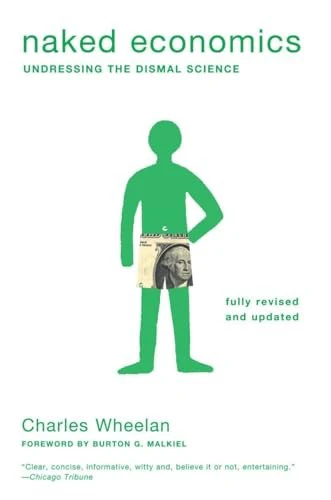
Naked Economics
Charles Wheelan • Non-fiction
Naked Economics by Charles Wheelan Summary
Naked Economics is a clear, engaging introduction to economic principles, designed for readers with no formal background in the field. Wheelan strips away jargon to explain how incentives, markets, trade, government policy, and global forces shape modern life. Each market transaction makes all parties better off by facilitating resource allocation and contributing to market efficiency, illustrating how markets work to optimize outcomes. The book explores topics such as productivity, unemployment, inflation, globalization, education, inequality, and the role of institutions, using real-world examples to show how economics influences everyday decisions and national outcomes. These examples also demonstrate how consumer spending is shaped by market dynamics, entry barriers, and pricing strategies. Each chapter highlights the human behavior behind economic systems, revealing how individuals respond to incentives and how perverse incentives can lead to unintended and counterproductive economic outcomes. The book also examines how societies balance efficiency with fairness. Issues such as income inequality and wealth distribution are addressed as key economic challenges that shape policy debates. Ultimately, Wheelan argues that economics is a powerful tool for understanding choices, predicting outcomes, and improving public policy—provided it is applied with nuance and awareness of its limitations. The book discusses the role of government intervention in correcting market failures and promoting policies that benefit society as a whole. It emphasizes the importance of effective government institutions, protecting property rights, and distinguishing between the functions of government and the private sector in fostering economic growth. Wheelan also explores how organized interests and interest group politics influence public policy and economic outcomes. The book covers the role of the Federal Reserve, monetary policy, and the US economy in shaping both domestic and global economic conditions. It explains how purchasing power and exchange rates affect the ability to buy foreign goods, and discusses international trade and global trade, highlighting their impact on prosperity and the challenges involved. Development economics is addressed, with attention to the challenges faced by poor countries and the importance of tailored interventions for growth. Finally, the book underscores the significance of human capital as a driver of productivity and economic development.
Financial Markets and Instruments
Financial markets are the backbone of a thriving market economy, serving as the meeting point where savers and borrowers, investors and businesses, come together. These markets—ranging from stock exchanges to bond markets and beyond—make it possible for companies to raise the capital they need for productive investments, which in turn fuels economic growth and innovation. By channeling savings into investments, financial markets help ensure that resources are allocated efficiently across the entire economy.
For individuals, financial markets offer opportunities to grow wealth, manage risk, and plan for the future through a variety of financial instruments like stocks, bonds, and mutual funds. For businesses and governments, access to these markets is essential for funding new projects, expanding operations, and responding to changing economic conditions. The smooth functioning of financial markets is crucial not only for personal finance but also for the stability and growth of the global economy.
Understanding how financial markets operate empowers people to make better decisions—whether it’s investing for retirement, starting a business, or simply grasping how market forces influence economic behavior. In Naked Economics, Charles Wheelan demystifies these complex economic concepts, showing how financial markets underpin the prosperity of modern societies and why their health is vital for sustained economic growth.
Analysis of Economic Principles
Wheelan succeeds at making complex ideas accessible without oversimplifying. The book’s strength lies in connecting theory to practical, relatable scenarios, highlighting economics as a behavioral and social science rather than a purely mathematical one. It critiques policies that ignore incentives and emphasizes the importance of institutions in creating prosperity. The work remains an excellent foundational text for anyone looking to decode the forces shaping modern economies.
Level up your reading with Peech
Boost your productivity and absorb knowledge faster than ever.
Start now