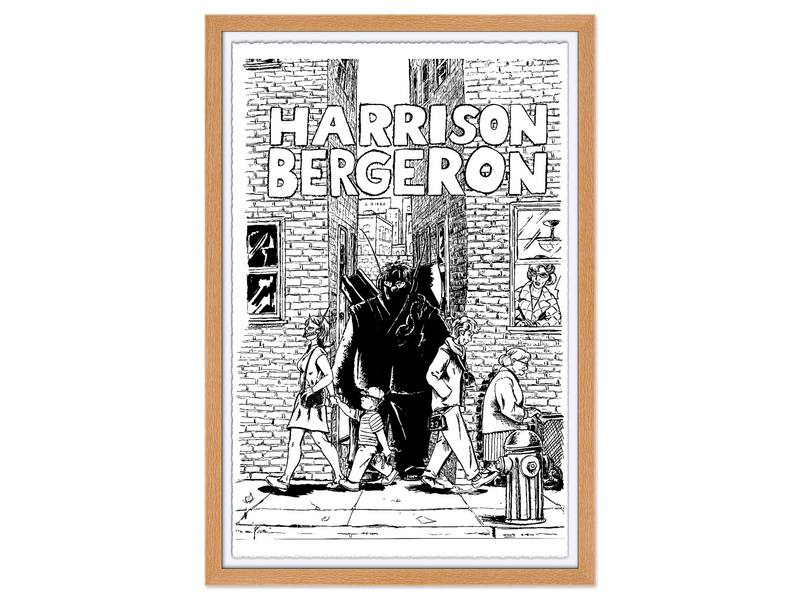
Harrison Bergeron Summary
Kurt Vonnegut • Dystopian science-fiction, Satire
Harrison Bergeron Summary: Book, Characters, and Analysis by Kurt Vonnegut
Harrison Bergeron by Kurt Vonnegut is a dystopian story and short story that critiques enforced equality, authoritarian control, and the suppression of individuality in the name of social harmony. As a significant literary work, Kurt Vonnegut's Harrison Bergeron is set in a future America where the government mandates absolute equality through physical and mental handicaps, using sharp satire to expose how well-intentioned ideals can devolve into dehumanizing tyranny. Vonnegut's Harrison Bergeron continues to provoke thought and analysis about the dangers of excessive government control and the loss of individual freedoms.
Introduction to the Story
Kurt Vonnegut’s “Harrison Bergeron” stands as a classic example of dystopian science fiction, delving into the consequences of a future society obsessed with the idea of absolute equality. The story focuses on the Bergeron family—George and Hazel Bergeron and their fourteen-year-old son, Harrison—living in a world where the government has taken extreme measures to ensure that no one is smarter, stronger, or more talented than anyone else. In this society, intelligent members and those with any exceptional abilities are forced to wear handicaps, devices designed to suppress their natural gifts and maintain a level playing field for all citizens.
The story takes place in the year 2081, a time when the pursuit of true equality has become law, and individuality is seen as a threat to social order. George and Hazel, the parents, represent the average citizens: George, burdened by mental handicaps to limit his intelligence, and Hazel, who is perfectly average and unencumbered. Their son, Harrison Bergeron, is the title character—a fourteen-year-old boy whose extraordinary abilities make him a target for the government’s most severe restrictions. Harrison’s struggle against these constraints becomes a powerful symbol of individuality and resistance in a world determined to rid society of difference.
Vonnegut’s point in “Harrison Bergeron” is to question whether forced equality truly benefits society, or if it simply erases the qualities that make people unique. The story uses the Bergeron family’s experiences to explore the dangers of government overreach and the loss of personal freedom. As a short story, it raises important questions about the value of diversity, the risks of forced conformity, and the meaning of true equality. Whether interpreted as a critique of socialism, a warning against authoritarianism, or a meditation on the human spirit, “Harrison Bergeron” remains a thought-provoking work that challenges readers to consider the costs of sacrificing individuality for the illusion of fairness.
Book Summary of Harrison Bergeron
The story is set in the year 2081, a time when the U.S. government has enacted constitutional amendments to ensure that no citizen is smarter, stronger, or more attractive than any other. Equality is no longer a moral aspiration but a legally enforced condition. To achieve this, citizens deemed above average are required to wear their own handicaps—devices that neutralize exceptional ability.
George Bergeron, who is highly intelligent, wears a mental handicap radio that emits loud noises to disrupt his thoughts. He is also forced to wear a canvas bag filled with lead balls—over 40 pounds—around his neck to limit his strength. His wife, Hazel, who is of average intelligence, wears no handicaps and struggles to retain information or engage in sustained reasoning. At one point, Hazel suggests that George could take a rest by removing some of the lead balls, but George refuses, fearing punishment. Hazel also expresses a wish to hear all the different sounds that George hears from his handicap radio, showing her curiosity about sensory experiences. Their lives are defined by passive consumption, particularly TV, which functions as both distraction and ideological reinforcement.
Their son, Harrison Bergeron, is fourteen years old and stands seven feet tall, making him physically imposing. He is extraordinarily gifted—strong, intelligent, and charismatic. Because of his exceptional abilities, Harrison is burdened with extreme handicaps, including a red rubber ball on his nose to make him look less attractive, and is eventually arrested by the government for attempting to overthrow the government. The government describes him as extremely dangerous. His imprisonment establishes him as a threat not because of violence, but because of potential.
While Harrison's parents watch TV, a news bulletin interrupts the program, reporting Harrison's escape. The news announcer struggles with a speech impediment imposed by the government, and a ballerina with a beautiful voice reads the bulletin instead. The scene shifts to the television studio, where Harrison storms in, removes his handicaps, and declares himself emperor. He demands a woman to join him, and a ballerina steps forward to become his empress. Together, they remove their handicaps and share a long kiss as they dance, symbolizing liberation and raw emotion.
The moment is brief. Diana Moon Glampers, the Handicapper General, enters the studio and executes Harrison and the ballerina without hesitation. The broadcast resumes as if nothing happened. George, briefly shaken by emotion, is distracted by a noise from his mental handicap, while Hazel forgets the event entirely. When someone asks Hazel about what happened, she cannot remember, saying she always forgets sad things and that she only remembers sad things for a moment before they fade. The system reasserts itself, unchallenged and unquestioned.
The story ends in emotional emptiness, underscoring the efficiency of oppression when memory, intelligence, and resistance are systematically erased.
Main Characters in Harrison Bergeron
Harrison Bergeron
The titular character and symbolic rebel. Harrison represents individuality, excellence, and the human drive toward self-expression. His rebellion is theatrical and idealistic, fueled by pure will, revealing both the power and vulnerability of unrestrained freedom.
George Bergeron
Harrison’s father. Intelligent but subdued, George embodies compromised awareness. His mental handicap disrupts George's thoughts, preventing him from maintaining clear internal reflections. He recognizes injustice but lacks the capacity to sustain resistance under constant cognitive disruption.
Hazel Bergeron
Harrison’s mother. Average by societal standards, Hazel is emotionally present but intellectually disengaged. Her inability to remember tragedy reflects the success of systemic suppression.
Diana Moon Glampers
The antagonist and embodiment of state authority. Cold and efficient, she represents violence justified through law and the elimination of dissent.
Analysis of Harrison Bergeron
Major Themes
Equality vs. Equity
Vonnegut critiques a system that mistakes equality for uniformity. By enforcing sameness, society destroys excellence rather than elevating those in need.
Authoritarian Control
The government’s power lies not only in violence, but in cognitive suppression. Control is maintained by limiting thought, memory, and emotional continuity.
The Cost of Mediocrity
The story argues that suppressing difference leads to cultural and emotional stagnation, not harmony.
The Illusion of Consent
Citizens appear compliant not because they agree, but because they are incapable of sustained dissent.
Symbolism and Literary Devices
- Handicaps symbolize institutionalized suppression of potential
- Wear masks illustrates how characters are forced to hide their beauty to enforce equality, symbolizing the suppression of individuality and the promotion of uniformity
- Television represents passive indoctrination
- The ballerina’s dance embodies aesthetic and human freedom
- Noise disruptions reflect fragmentation of thought
- Abrupt violence emphasizes the fragility of rebellion
Vonnegut’s flat, almost casual tone intensifies the horror by normalizing cruelty, forcing readers to confront how easily freedom can be erased. 'Harrison Bergeron' is part of Vonnegut's satirical collection, 'Welcome to the Monkey House,' which explores themes of social commentary and dystopian control.
Author Background and Historical Context
Kurt Vonnegut was an American writer known for blending satire with moral urgency. Written during the Cold War, Harrison Bergeron reflects anxieties about conformity, state power, and ideological extremism, particularly in societies that prioritize stability over freedom.
Harrison Bergeron: Impact and Legacy
The story remains one of Vonnegut’s most frequently anthologized works. Its relevance has endured as debates about equality, censorship, and state control continue to shape modern political discourse.
Who Should Read Harrison Bergeron by Kurt Vonnegut
- Readers interested in dystopian fiction
- Students studying political satire
- Those exploring freedom, equality, and authority
- Readers drawn to short fiction with philosophical weight
Level up your reading with Peech
Boost your productivity and absorb knowledge faster than ever.
Start now