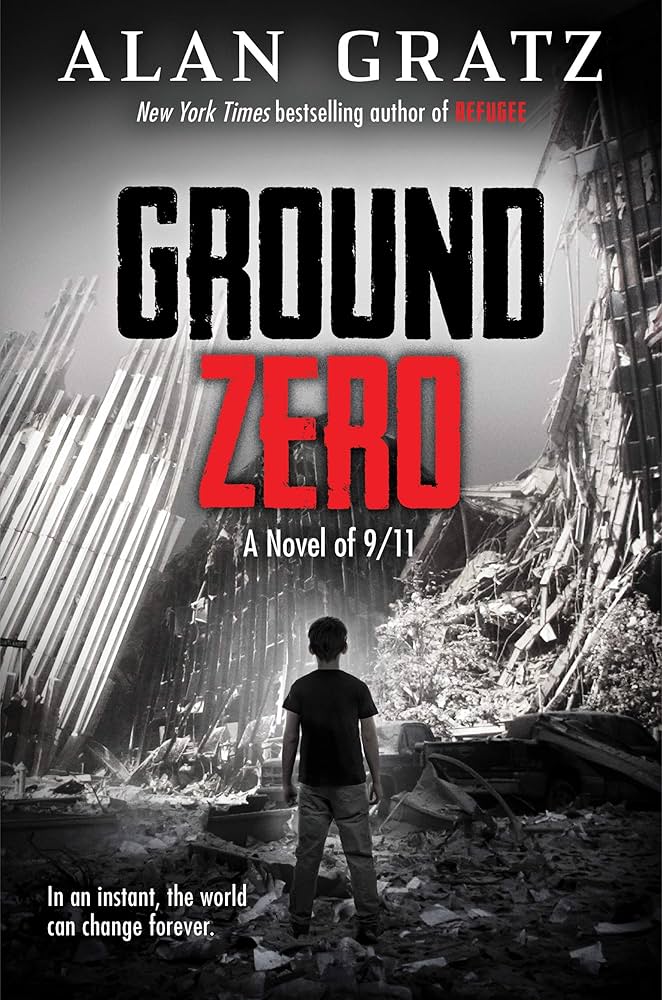
Ground Zero
Alan Gratz • Historical Fiction
Ground Zero by Alan Gratz Summary
Ground Zero by author Alan Gratz, published by Scholastic Press, is a powerful and emotional novel crafted for middle grade readers that intertwines two perspectives—two parallel stories separated by nearly two decades but bound by the shared tragedy of war and terrorism. It explores how the events of September 11, 2001, shaped not only the lives of those who lived through it but also generations to come.
The first storyline unfolds on September 11, 2001, through the eyes of Brandon Chavez, a nine-year-old boy visiting his father, the kitchen manager at Windows on the World in the North Tower of the World Trade Center. What starts as an ordinary day in New York City quickly descends into chaos when the plane hit the North Tower. Earlier that morning, Brandon had been suspended from school for stealing a pair of expensive Wolverine gloves from a friend, and he visits the underground mall beneath the towers to buy replacement gloves. In an instant, Brandon’s world shatters — fire, smoke, and confusion engulf the building, and the ordinary office becomes a fiery nightmare of debris and fear. As the second plane crashes into the South Tower, the situation escalates. Separated from his father after the impact, Brandon calls his dad during the chaos, and his dad reassures him, offering support and hope amid the disaster. Brandon grabs a Tasmanian devil stuffed animal as a token of luck before summoning courage far beyond his years to find a way out. Guided by instinct and compassion, Brandon’s actions help others escape the collapsing skyscraper, facing impossible choices and unimaginable loss, including the death and profound loss experienced by both Brandon and Leo Chavez.
The second storyline takes place in Afghanistan in 2019, nearly two decades after 9/11. Here, we follow Reshmina, an eleven-year-old Afghan girl living in a small mountain village ravaged by the long aftermath of the U.S. invasion. Her life has been shaped entirely by conflict — drones overhead, bombed schools, and families divided between hope and despair. When a wounded American soldier named Taz stumbles into her village after a battle with the Taliban, Reshmina is forced to make a life-altering decision: should she help the soldier, risking her entire family’s safety, or turn him away and protect her people? Taz later gives Reshmina a Tasmanian devil stuffed animal, echoing Brandon’s token of luck and providing comfort amid trauma. Reshmina’s dreams for peace and education drive her actions, even as her world is shaped by violence.
As the story alternates between Brandon’s desperate fight for survival in New York and Reshmina’s moral struggle in Afghanistan, Gratz builds a gripping narrative that connects two children separated by time but united by the shared cost of violence and misunderstanding. Both characters are caught in moments that test their courage, empathy, and ability to see humanity amid horror, despite living in worlds apart.
Through their eyes, readers witness not only the initial devastation of 9/11 but also its enduring impact on a new generation of Americans—soldiers and civilians alike—affected by the wars in Afghanistan and the events of 9/11. The narrative contrasts the past (the tragedy of September 11) with the present (the ongoing conflict in Afghanistan in 2019), highlighting the ongoing consequences and the way history shapes current realities. The two perspectives converge thematically in a moving reflection on how acts of kindness, forgiveness, and courage can emerge even in humanity’s darkest hours. Ground Zero is not just a story about war and terrorism — it is about resilience, the choices that define us, the dreams that sustain us, and the fragile but powerful threads that connect us all across worlds and generations.
Plot Devices
Alan Gratz masterfully employs parallel storytelling as the central device, interweaving Brandon’s and Reshmina’s experiences across different eras. This structure allows readers to see the immediate and long-term consequences of 9/11 from two deeply human perspectives — one in the heart of the event and one in its global aftermath.
The use of dual timelines creates tension and reflection: while Brandon’s story unfolds moment by moment in the collapsing towers, Reshmina’s takes place in the lingering shadow of those same attacks, where war has become routine. Gratz also uses mirroring — both children face moral decisions that test their understanding of right and wrong, survival and compassion.
Symbolism is another powerful device. The collapsing towers symbolize the destruction of innocence, while the mountains of Afghanistan represent endurance and the search for peace in a fractured world. The recurring motif of fire and dust ties both stories together — one from falling buildings, the other from explosions in the desert — reminding readers that violence spreads far beyond its point of origin.
Finally, Gratz relies on real-time pacing and vivid sensory details to pull readers into each moment, making the fear, confusion, and courage of his young characters feel tangible and immediate.
Characters
- Brandon Chavez – A brave nine-year-old kid caught in the North Tower during the attacks. He is helped by Richard Lowery, a heroic figure who saves him during the September 11 attacks. Brandon's transformation from a frightened child to a determined survivor forms the emotional heart of the book. His courage and empathy, especially in helping others despite his fear, make him a symbol of resilience.
- Richard Lowery – A heroic character who rescues Brandon, the kid, during the September 11 attacks. His actions highlight bravery and selflessness in the face of disaster.
- Brandon’s Father – A window washer working in the tower. His love for his son and his sacrifice underline the theme of parental protection and loss.
- Reshmina – An eleven-year-old Afghan girl wise beyond her years. Torn between loyalty to her family and her sense of humanity, she embodies the complexity of growing up in a world defined by conflict.
- Pasoon – Reshmina’s twin brother, who represents the anger and disillusionment that arise from living under constant occupation. His choices contrast Reshmina’s compassion, reflecting the divided emotions of a war-torn generation.
- Taz – The wounded American soldier whose encounter with Reshmina forces both to question their assumptions about “enemy” and “ally.” His vulnerability humanizes the faceless image of war.
Each character mirrors the other timeline — Brandon’s bravery echoes Reshmina’s compassion, showing that heroism takes many forms and transcends geography or religion.
Historical Context and Significance
Set against two of the most pivotal events in recent history, Ground Zero by Alan Gratz offers readers a window into the world-changing impact of the September 11 attacks on the World Trade Center and the ongoing war in Afghanistan. The novel’s dual timelines—one following Brandon Chavez, a nine-year-old boy caught in the North Tower when the first plane hits, and the other centering on Reshmina, a young girl navigating life in a village torn apart by the conflict between the Taliban and American forces—bring these historical events to life in unexpected ways.
The World Trade Center, with its iconic North Tower and South Tower, is more than just a setting; it’s a symbol of both tragedy and resilience. Through Brandon’s eyes, readers experience the chaos and mortal danger unleashed when the plane crashes into the North Tower, forever altering the lives of families and communities. Alan Gratz’s vivid storytelling captures the confusion, fear, and bravery that defined that September morning, making the historical event accessible and deeply personal for younger readers.
Meanwhile, the story’s alternating chapters transport readers to Afghanistan, where the aftermath of 9/11 continues to shape daily life. Reshmina’s family, like so many others, is caught in the crossfire between the Taliban and American soldiers. The presence of a wounded American soldier, Taz, in her village forces difficult choices and highlights the far-reaching consequences of war. Gratz’s portrayal of the Afghan national army, the struggles of civilians, and the complex relationship between American forces and local families provides a nuanced perspective rarely found in middle grade fiction.
Ground Zero stands out as a great resource for both kids and adults seeking to understand the human stories behind these historical events. The author’s note at the end of the book offers additional insight, making it an invaluable tool for schools and families wanting to discuss the impact of terrorism, war, and hope. The use of alternating perspectives not only enriches the narrative but also encourages empathy, helping readers see the world through the eyes of both a young American boy suspended from school and an Afghan girl fighting for her family’s survival.
The novel’s critical acclaim, including its status as a New York Times bestseller, speaks to its power and relevance. By weaving together the experiences of Brandon, his father, Reshmina, and the American soldiers, Alan Gratz invites readers to reflect on the ways historical events shape lives across the globe. Ground Zero is more than a story of survival; it’s a testament to the enduring strength of families, the importance of understanding different perspectives, and the hope that can emerge even in the darkest moments of history.
Analysis
Gratz’s novel is as educational as it is emotionally gripping. By presenting 9/11 and its consequences through the eyes of children, he strips away politics and ideology, focusing instead on empathy and survival. The alternating timelines provide a balanced perspective — the trauma of those who lived through the attacks and the pain of those still living in the wars that followed. The novel also highlights how adults and children process traumatic events differently, with adults often carrying deeper, long-term emotional scars while children may react with confusion or immediate fear.
Thematically, Ground Zero explores the cyclical nature of violence, the innocence of youth amid chaos, and the possibility of understanding across cultures. The contrast between Brandon’s immediate terror and Reshmina’s lifelong fear of foreign soldiers emphasizes how interconnected our world has become — and how trauma reverberates far beyond its source.
Stylistically, Gratz writes with cinematic clarity and fast-paced urgency, appealing especially to young readers while maintaining emotional depth. His accessible prose makes complex historical events personal and relatable. Notably, Taz tells Reshmina stories about his own experiences, such as his memories of the September 11 attacks, which helps bridge understanding between characters from different backgrounds. Critics have praised his ability to foster empathy — showing readers that behind every headline, there are human lives intertwined by both tragedy and hope.
Conclusion
Ground Zero is a remarkable work of historical fiction that bridges two generations, two countries, and two very different experiences of the same global event. It challenges readers to look beyond borders and headlines, urging compassion over fear and understanding over revenge.
Through Brandon and Reshmina, Alan Gratz reminds us that courage often appears in the smallest moments — in the decision to help a stranger, to forgive an enemy, or simply to survive another day. Both heartbreaking and inspiring, Ground Zero stands as one of the most accessible and emotionally resonant portrayals of 9/11 for young readers, offering a lasting message: even in the midst of destruction, humanity endures.
Level up your reading with Peech
Boost your productivity and absorb knowledge faster than ever.
Start now