Common Sense Summary
Thomas Paine • Non-fiction
Common Sense by Thomas Paine Summary – Book Characters, and Analysis
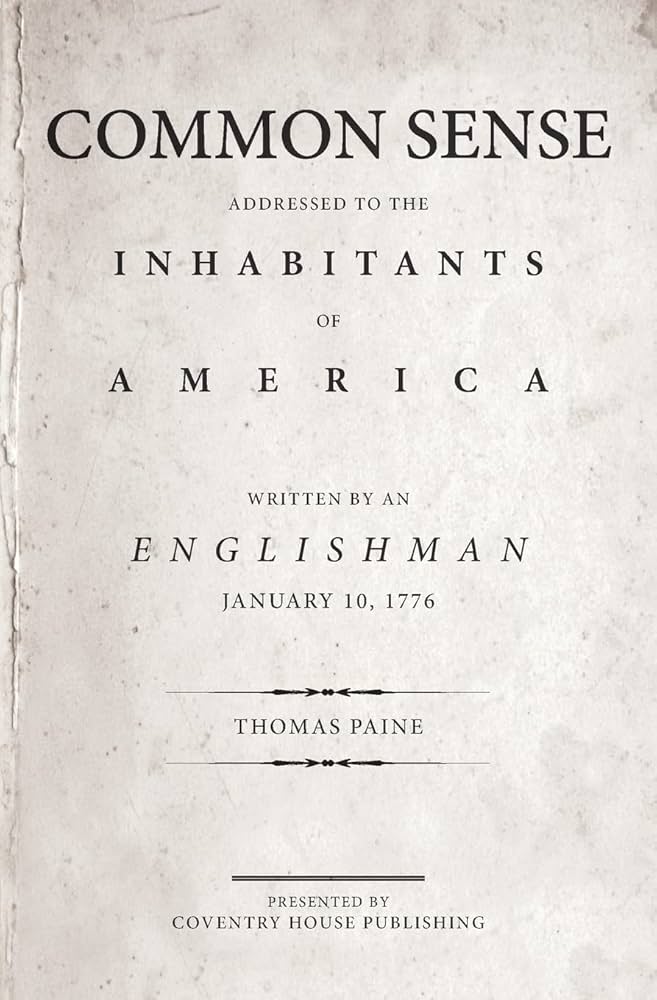
Common Sense by Thomas Paine is a revolutionary political pamphlet, widely distributed as a printed pamphlet, that played a crucial role in shaping public opinion during the American Revolution. Thomas Paine's Common Sense served as a catalyst for American independence. Published in 1776, the work argues forcefully for independence from British rule and challenges the legitimacy of monarchy and hereditary power, with a central focus on advocating for American independence.
This article provides an extended book summary, an overview of the key figures and ideas, and a critical analysis of Common Sense, focusing on its arguments, rhetoric, and historical importance.
Book Summary of Common Sense by Thomas Paine
Common Sense is written as a persuasive political argument aimed at ordinary colonists rather than elites or scholars. Paine’s goal is to convince readers that continued allegiance to Great Britain is irrational, unjust, and harmful, and that full independence is both necessary and inevitable.
Paine begins by distinguishing society from government. Society, he argues, is a natural good that arises from human cooperation, while government arises out of necessity as a necessary evil created to restrain human vices. This distinction allows Paine to frame government as something that exists to serve the people, not to dominate them.
Paine addresses the flaws of monarchy and hereditary succession. He then launches a direct attack on monarchy and hereditary succession, calling them absurd and immoral systems. Paine rejects the idea that any family has a natural right to rule others, arguing that monarchy promotes inequality, corruption, and tyranny. He also uses biblical references to show that even scripture does not support kingship, appealing to the religious sensibilities of his audience.
The pamphlet next turns to the political relationship between the American colonies and Britain. Paine dismantles the argument that Britain protects the colonies, asserting instead that the British Empire’s involvement has dragged America into unnecessary wars and economic exploitation. He argues that America has outgrown the need for British rule and that continued dependence on a foreign power only prolongs suffering.
Paine's arguments for independence are both logical and moral, emphasizing the need for self-governance and the rejection of oppressive rule. Paine emphasizes the practical benefits of independence, including economic freedom, international trade, and political self-determination. He proposes a republican government, outlining a basic framework for representation and lawmaking rooted in the consent of the governed. Such a system, Paine argues, would be more just and stable than monarchy, ensuring that power resides with the people rather than a hereditary ruler.
In the final sections, Paine appeals to urgency and moral responsibility. He frames independence as a historic opportunity that must not be delayed, warning that reconciliation with Britain would only lead to further conflict. His language grows increasingly emotional and prophetic, urging readers to act decisively and embrace their role in shaping history.
Key Figures and Concepts in Common Sense
The American Colonists
Though not individual characters, the colonists are Paine’s primary audience. He addresses them as rational actors capable of self-governance and moral judgment.
The British Monarchy and Hereditary Succession
Presented as a symbol of tyranny, corruption, and irrational authority, Paine argues that the concentration of power in a single person inevitably leads to these problems. Paine treats monarchy not as a flawed institution, but as a fundamentally illegitimate one.
Government
Defined as a human-made system meant to protect liberty, government is designed to regulate and safeguard human affairs. Paine’s conceptual treatment of government is central to his argument.
Republicanism
The political ideal Paine promotes, based on representation, equality before the law, and popular sovereignty.
Analysis of Common Sense by Thomas Paine
Major Themes
Liberty and Self-Government
Paine argues that freedom is a natural right and that people are capable of governing themselves without kings or inherited rulers.
Reason Over Tradition
The pamphlet challenges long-standing political traditions, urging readers to rely on logic and moral reasoning rather than custom.
Moral Responsibility
Independence is framed as not only practical but ethical. Paine suggests neutrality or delay is a form of complicity.
Equality
By rejecting hereditary power, Paine promotes the idea that all individuals are born politically equal.
Rhetoric and Writing Style
Paine uses direct, accessible language rather than philosophical jargon. His use of analogies, biblical references, and emotional appeals makes complex political ideas understandable to a broad audience. The pamphlet’s clarity and urgency are central to its persuasive power.
At the end, Paine offers miscellaneous reflections on the broader implications of independence, emphasizing the emotional, moral, and personal motivations for seeking a just and better future.
Ability and Potential of the American Colonies
In Common Sense, Thomas Paine makes a compelling case for the ability and potential of the American colonies to stand as an independent nation. Paine argues that the time has come for America to break free from the oppressive nature of British rule and to embrace self-governance. He points to the present ability of America, emphasizing the colonies’ robust economy, abundant resources, and the collective determination of the people to seek independence.
Paine begins by highlighting the economic strengths of the American colonies. He notes that America’s natural resources, thriving trade, and growing population provide a solid foundation for a new nation. While the British navy has offered protection, Paine argues that this so-called benefit has come at a steep price—taxation without representation, restricted trade with other nations, and the constant threat of being drawn into Britain’s civil wars and conflicts with foreign powers. Paine promises that, as an independent nation, America could build its own navy, open trade with other countries, and secure its own future without relying on Great Britain.
A central part of Paine’s argument is his critique of the English constitution and the system of hereditary succession. He denounces hereditary monarchy as a form of eternal tyranny, perpetuating inequality and corruption across generations. Paine’s plain arguments and emotional appeal resonated with his readers, including influential figures like John Adams, by emphasizing the moral virtue of self-governance and the urgent need for a new government based on republican principles.
In addressing the present state of American affairs, Paine acknowledges the fears of those who oppose independence—concerns about civil wars, instability, and the unknown future. Yet, he offers a vision of unity and hope, proposing a continental charter that would bring the colonies together under a single, representative government. Paine’s vision is not just for the present generation, but for future generations who would inherit a free nation built on the principles of liberty, equality, and justice.
The impact of Paine’s arguments in Common Sense on American history cannot be overstated. His pamphlet galvanized public opinion, inspired the Continental Congress, and helped transform the desire for reform into a rallying cry for full independence. Paine writes that America’s present ability is not only a matter of resources or geography, but of the people’s resolve to shape their own destiny and to serve as an example for other nations seeking freedom.
Ultimately, Paine’s analysis of the ability and potential of the American colonies helped lay the groundwork for the American Revolution and the creation of a new nation. His call for self-governance, his critique of monarchical rule, and his faith in the American people’s capacity for nation building continue to influence political thought and public opinion to this day. As America emerged from the shadow of Great Britain, it did so with the conviction that it could—and should—chart its own course, not just for itself, but for the benefit of future generations and the wider world.
Author Background and Historical Context
Thomas Paine was an English-born political writer and radical thinker who immigrated to the American colonies shortly before the Revolution. The Stamp Act was one of the key events that fueled colonial unrest, as it imposed oppressive taxes and heightened tensions between Britain and the colonies. Common Sense was published at a critical moment, when many colonists still favored reconciliation with Britain. The pamphlet sold widely and helped shift public opinion toward independence. Around this time, the Continental Army was formed to unify colonial military efforts against British rule, with George Washington appointed as its Commander-in-Chief, marking a significant step in the Patriots' fight for independence.
Common Sense by Thomas Paine: Impact and Legacy
Common Sense became one of the most influential political texts in history. It energized the revolutionary movement, shaped democratic ideals, and influenced later political documents, including the Declaration of Independence. Paine's arguments were crucial in rallying support for independence, emphasizing that breaking from Britain would protect America from external threats and internal tyranny. He also advocated for the free exercise of religion, highlighting it as a fundamental right that should be safeguarded in the new nation.
Who Should Read Common Sense by Thomas Paine
- Readers interested in political philosophy
- Students of American history
- Those exploring democracy, liberty, and governance
- Anyone studying the origins of modern republican thought
Level up your reading with Peech
Boost your productivity and absorb knowledge faster than ever.
Start now