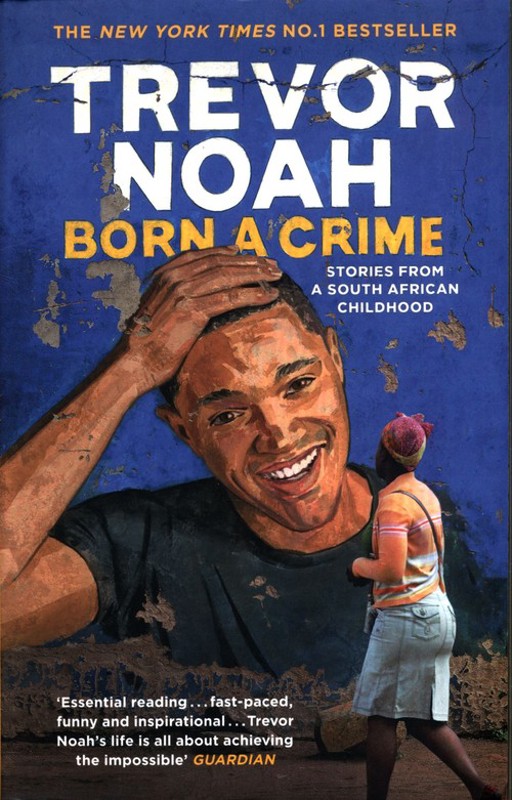
Born a Crime Summary
Trevor Noah • Humor, Autobiography
Born a Crime by Trevor Noah Summary: Book Characters and Analysis
Born a Crime by Trevor Noah is a memoir that blends personal narrative, social history, and sharp humor to explore identity, race, and survival under apartheid and post-apartheid South Africa. The book is a personal account of a South African childhood shaped by apartheid and its aftermath. While much of Trevor Noah's story unfolds in Johannesburg, Cape Town also features as a significant location in his early life, providing important geographical and cultural context.
Through stories drawn from his childhood, Noah examines how systems of oppression shape daily life and how resilience, language, and comedy become tools of resistance.
This article provides an extended book summary, a detailed overview of the characters, and a literary analysis of Born a Crime.
Book Summary of Born a Crime
The memoir takes its title from the circumstances of Trevor Noah’s birth. He is born to a Black Xhosa mother and a white Swiss father at a time when such relationships are illegal under South Africa’s apartheid laws. Patricia’s relationship with a white man was not only taboo but also a criminal act under apartheid. Trevor’s very existence is evidence of a crime, forcing his parents to hide their relationship and limiting his access to public spaces where his presence could draw dangerous attention. Noah explains how white people enforced and benefited from apartheid, contrasting their experiences with those of black South Africans.
Trevor’s childhood is defined by instability, secrecy, and adaptation. He is often kept indoors to avoid scrutiny, while his mother, Patricia Noah, moves between neighborhoods and identities to survive within a rigid racial hierarchy. Noah tells how Trevor and his mother lived in Alexandra, a township in Johannesburg known for poverty and crime, which shaped many of his early experiences. Trevor grows up in a society where race determines language, opportunity, and physical safety, and he quickly learns that survival depends on understanding social codes and navigating contradictions.
As a light skinned child, Trevor often felt caught between racial groups, which affected his interactions with black kids in the townships. Noah explains that his experiences differed from those of the black kids around him, as he struggled with a sense of belonging and identity.
Language becomes one of Trevor’s most powerful tools. By learning multiple languages—Zulu, Xhosa, Afrikaans, English, and others—he gains access to different communities and defuses conflict. Noah explains the importance of being able to speak English and other official languages in South Africa, and how this helped him navigate different communities. South Africa has multiple official languages, and Trevor’s ability to speak several of them was a key asset in overcoming social barriers.
The memoir interweaves personal anecdotes with broader social commentary. Trevor recounts experiences with poverty, crime, and religious extremism, often using humor to expose the absurdities and cruelties of apartheid logic. School, church, and the streets each present distinct dangers, teaching Trevor that rules are often arbitrary and selectively enforced. Noah tells how he attended three churches with his mother, each reflecting different racial and cultural communities in post-apartheid South Africa.
A central emotional thread of the book is Trevor’s relationship with his mother. Patricia is fiercely independent, deeply religious, and unwilling to accept the limitations imposed on her by society. Patricia was known for pushing boundaries, both in her personal life and in raising her son. She instills in Trevor a belief in self-worth and critical thinking, even when her choices expose them to danger. Patricia’s roots in the Xhosa tribe influenced her values and resilience. Patricia meets Robert, Trevor’s father, and later Abel, who becomes Noah’s stepfather. Her strength anchors the narrative and provides its moral center.
Noah tells of the most harrowing episodes involving domestic violence perpetrated by Noah’s stepfather, Abel, whose abuse culminates in an attempt on Patricia’s life. Trevor realizes the lasting psychological effects of violence, recognizing how cycles of trauma persist even after apartheid officially ends. In one incident, a house is burned down, illustrating the dangers and unpredictability of township life. Patricia survived being shot by Abel, and Andrew, Trevor’s brother, was a witness to the violence.
Noah explains that after the shooting, the involvement of local police highlighted the challenges of seeking justice in marginalized communities. The response of local police underscored the broader issues of law enforcement in South Africa.
Noah tells of his experiences with the most beautiful girl and a beautiful girl at school, highlighting the emotional significance of these encounters, especially during prom night. Friends played a crucial role in Trevor’s life, helping him navigate the challenges of apartheid and providing support through difficult times.
Trevor had his fair share of trouble and challenges growing up, often pushing boundaries and learning important life lessons along the way.
A few years after the events described, Trevor reflected on how his experiences shaped his outlook and contributed to his growth.
Noah explains that Trevor’s father, Robert, was a white man whose relationship with Patricia was shaped by the legal and social restrictions of apartheid. Their connection influenced Trevor’s identity as the son of a mixed-race mother and a white father, and the complexities of their relationship are woven throughout the memoir.
While apartheid’s legal structure collapses, its social consequences remain. Trevor’s success does not erase his past; instead, it reframes it as testimony to endurance and adaptability rather than escape.
Family Background and Upbringing
Trevor Noah’s family background is at the heart of Born a Crime, shaping every aspect of his early life in apartheid South Africa. As a mixed race child—born to Patricia Nombuyiselo Noah, a black Xhosa woman, and Robert, a white Swiss man—Trevor’s very existence was considered illegal under the apartheid regime. This reality forced his parents to keep their relationship hidden, and Trevor’s birth itself was an act of defiance against a system designed to keep different races apart.
Growing up in Eden Park, a neighborhood designated for colored people, Trevor often felt like an outsider. His light skin and ability to speak multiple languages, including English, Zulu, and Afrikaans, set him apart from other kids and allowed him to move between different communities. Patricia, Trevor’s mother, was a constant presence and a strong woman who pushed boundaries and refused to let the apartheid system define her or her son’s future. She instilled in Trevor a sense of independence, curiosity, and resilience, encouraging him to question authority and seek a better life beyond the limitations imposed by society.
Trevor’s father, Robert, played a quieter but significant role, his relationship with Trevor shaped by the need for secrecy. Despite the challenges, Trevor’s family life was filled with love, humor, and a determination to survive. The lessons Trevor learned from his mother—about faith, language, and self-worth—became the foundation for his ability to navigate the complexities of South African society as a mixed child born a crime.
Main Figures in Born a Crime
Trevor Noah
The author and protagonist. Curious, observant, and resilient, Trevor uses humor and language as survival strategies. His narrative voice balances vulnerability with insight, transforming personal experience into social critique.
Patricia Noah
Trevor’s mother and the memoir’s moral core. Intelligent, rebellious, and unwavering, Patricia resists both apartheid and patriarchal control. Her belief in Trevor’s potential shapes his capacity to imagine a life beyond imposed limits.
Robert
Trevor’s father. Quiet and distant due to legal necessity, Robert represents the constraints apartheid placed on intimacy and family formation.
Abel
Trevor’s stepfather. Charismatic and violent, Abel embodies how toxic masculinity and systemic instability fuel domestic abuse.
Plot and Structure
Born a Crime unfolds as a series of vivid vignettes, each capturing a different facet of Trevor Noah’s journey through childhood and adolescence in apartheid South Africa. Rather than following a strict chronological order, the memoir is organized into 18 chapters, each prefaced with historical context that helps readers understand the broader forces shaping Trevor’s life and the lives of black South Africans.
The structure allows Trevor to move fluidly between personal stories and the harsh realities of the apartheid system. Through these snapshots, readers witness Trevor’s struggles as a mixed race child—navigating a world where his very existence is a crime, and where belonging is always just out of reach. The memoir delves into the complexities of family life, the impact of domestic violence at the hands of his stepfather, and the resilience required to survive in a society marked by racism, poverty, and constant danger.
By weaving together humor, heartbreak, and historical insight, Trevor crafts a story that is both deeply personal and universally resonant. The episodic format not only mirrors the fragmented nature of memory but also highlights the ways in which individual lives are shaped by the larger currents of history. Through his story, Trevor Noah offers a powerful crime summary of life under apartheid, illuminating the enduring effects of systemic oppression on families and communities.
Analysis of Born a Crime
Major Themes
Identity Under Oppression
Noah shows how identity is shaped not only by race, but by how society responds to it. Being mixed-race places Trevor everywhere and nowhere at once.
Language as Power
Language functions as access, protection, and connection. Speaking to people in their own language becomes an act of empathy and strategy.
Humor as Resistance
Comedy is not escapism but survival. Humor allows Noah to expose injustice without surrendering to bitterness.
Legacy of Apartheid
The memoir argues that legal change does not immediately dismantle social harm. Inequality persists through habit, fear, and economic disparity.
Narrative Style and Literary Devices
- Episodic structure mirrors memory and oral storytelling
- Humor juxtaposed with violence heightens emotional impact
- Historical exposition contextualizes personal stories
- First-person reflection emphasizes moral accountability
Noah’s prose is accessible and conversational, yet grounded in sharp analysis and lived experience.
Author Background and Context
Trevor Noah is a South African comedian and former host of The Daily Show. His comedy and writing draw heavily from his upbringing in a racially stratified society. Born a Crime reflects both personal survival and sociopolitical awareness, bridging memoir and cultural history.
Born a Crime: Impact and Legacy
The memoir received widespread acclaim for its honesty, humor, and insight. It has become a widely taught text for discussions of race, identity, and postcolonial society, reaching audiences beyond traditional memoir readership.
Who Should Read Born a Crime by Trevor Noah
- Readers interested in memoir and social history
- Students studying race and identity
- Those exploring humor as cultural critique
- Readers seeking accessible yet profound nonfiction
Conclusion and Final Thoughts
In conclusion, Born a Crime stands as a remarkable memoir that brings to life the experiences of black South Africans during and after apartheid. Trevor Noah’s story is not just a personal account, but a tribute to the strength and determination of his mother, Patricia, whose unwavering support and courage helped him navigate a world stacked against them. As a South African comedian and global figure, Trevor Noah uses his unique voice to shed light on the complexities of identity, belonging, and resilience in the face of adversity.
This book review would not be complete without acknowledging the profound impact Born a Crime has had on readers worldwide. Through humor and honesty, Trevor Noah explores the ongoing struggles faced by black women and mixed-race children in South Africa, while also celebrating the power of family, love, and forgiveness. His story is a testament to the enduring spirit of those who refuse to be defined by the crimes of the past, and a reminder that even in the harshest circumstances, hope and humanity can prevail.
For anyone seeking to understand the legacy of apartheid South Africa, or simply looking for an inspiring and thought-provoking read, Born a Crime is an essential addition to your bookshelf. Trevor Noah’s journey from a child born a crime to a celebrated South African comedian is a powerful story of survival, transformation, and the unbreakable bonds of family.
Level up your reading with Peech
Boost your productivity and absorb knowledge faster than ever.
Start now