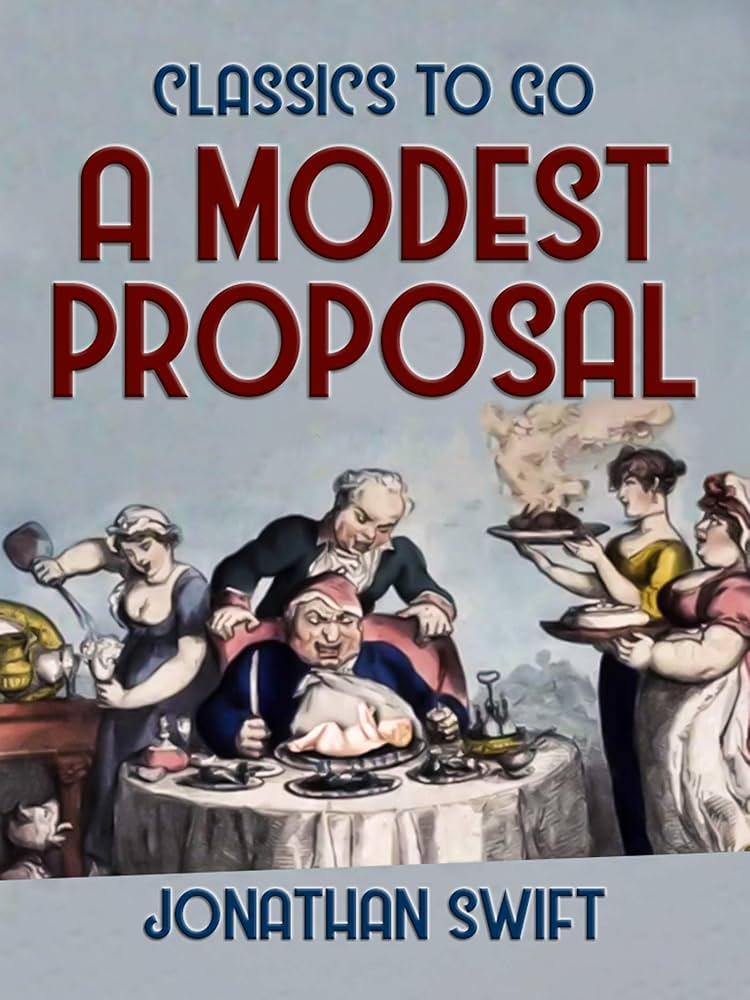
A Modest Proposal Summary
Jonathan Swift • Satirical essay
A Modest Proposal by Jonathan Swift Summary – Book Characters, and Analysis
Swift's Modest Proposal is a satirical essay that uses extreme irony to critique social indifference, economic exploitation, and political hypocrisy in 18th-century Ireland. By presenting a shocking solution to poverty, Swift exposes the moral bankruptcy of policies that reduce human beings to economic units.
Swift's mastery of satire and prose in the English language has made this work highly influential in later literature. As an early Georgian pamphlet, 'A Modest Proposal' reflects the historical and economic context of the early 18th century, particularly the mercantilist policies and social attitudes of the era.
This article provides an extended book summary, an overview of the narrative voice, and a literary analysis of A Modest Proposal.
Book Summary of A Modest Proposal
The essay begins with a calm, rational, and ostensibly well-meaning narrator who addresses the widespread poverty in the country of Ireland, particularly among impoverished women and children. The narrator observes that the streets are filled with begging mothers burdened by children they cannot feed, highlighting the burden on poor people and parents, and framing the issue as both a humanitarian and economic crisis for the nation.
After briefly acknowledging commonly proposed solutions—charity, domestic industry, and moral reform—the narrator dismisses them as impractical or insufficient, referencing similar pamphlets and their ineffectiveness. Swift introduces his “modest proposal” with false modesty, parodying the word modest in the title to mock the arrogance of such proposals. Swift suggests, with satirical argument, that poor Irish parents, including those with bastard children, sell children as food to wealthy landowners and the affluent. The proposal includes the shocking idea of using infant flesh as a delicious nourishing meal, which could equally serve whether stewed, roasted, baked, or boiled. This grotesque plan is presented as a way to greatly reduce the population and the burden on society, while providing income to poor families, supplying a new luxury product to the rich, and stimulating the economy of the nation.
The proposal is delivered with chilling logic. The narrator calculates costs, benefits, and culinary possibilities with detached precision, treating infants as livestock rather than human beings. He even suggests that one child per family could be sacrificed for the greater good, and that voluntary abortions might be considered among other extreme measures. The argument is methodically reinforced, anticipating objections and countering them, furthering the illusion of reasonableness in swift's proposal.
As the essay progresses, the narrator expands the supposed advantages of the plan, claiming it would strengthen marriage, encourage parental responsibility, and reduce crime. He frames cannibalism not as barbarism, but as enlightened pragmatism, and notes that such a plan would benefit wealthy landowners and the nation as a whole. The satire also targets religious prejudice, particularly the attitudes of protestant england toward irish catholics, and mocks the stereotypes and social injustices perpetuated by both English parents and Irish society.
In the final paragraphs, swift concludes by insisting on his own part and moral purity, stating that he has no personal stake in the plan because his own children are too old to be sold. This declaration underscores the hypocrisy and cruelty embedded in social policies that ignore human dignity while claiming moral authority, and parodies the false modesty of similar pamphlets.
The essay ends without revealing the satire explicitly, forcing readers to confront the logical endpoint of economic thinking divorced from empathy. Swift's essay remains a powerful critique of social injustice, religious prejudice, and the dehumanization of poor people, and its impact continues to resonate in literature and social commentary.
Narrative Voice (Functional “Character”)
The Proposer
Though unnamed, the narrator functions as a character. Polite, rational, and emotionally detached, he embodies the mindset Swift critiques: one that prioritizes efficiency over humanity and policy over people.
Analysis of A Modest Proposal
Major Themes
Dehumanization Through Economics
Swift exposes how the poor are reduced to numbers, burdens, or resources rather than recognized as human beings.
Moral Hypocrisy
The essay mocks policymakers who claim concern for the poor while endorsing systems that perpetuate suffering.
Colonial Exploitation
Ireland’s poverty is implicitly linked to English political and economic dominance, highlighting systemic injustice.
Rationality Without Ethics
Swift demonstrates how logic becomes monstrous when separated from moral responsibility.
Satirical Techniques and Literary Devices
- Irony as the central device
- Hyperbole to force moral clarity
- Economic diction to parody policy language
- Calm tone contrasting with horrific content
- False altruism to expose hypocrisy
Swift’s restraint intensifies the satire, making the proposal more disturbing by refusing emotional cues.
Author Background and Historical Context
Jonathan Swift was an Anglo-Irish writer and political satirist deeply critical of British rule in Ireland. Written during a period of extreme famine and poverty, A Modest Proposal was intended to shock complacent audiences into moral awareness.
A Modest Proposal: Impact and Legacy
The essay remains one of the most famous examples of satire in Western literature. It is frequently studied for its rhetorical mastery and enduring relevance to debates about poverty, policy, and human value.
Who Should Read A Modest Proposal by Jonathan Swift
- Readers interested in satire and political critique
- Students studying rhetoric and irony
- Those examining economic ethics
- Readers exploring colonial and social injustice
Conclusion and Final Thoughts
Jonathan Swift’s A Modest Proposal stands as a masterful example of the power of satire to confront society with its own failings. Through his infamous and ridiculous proposal of eating children, Swift forces readers to grapple with the harsh realities faced by the Irish poor and the indifference of government and society. The essay’s biting irony and carefully chosen words expose the dehumanization and exploitation of the Irish people, making a bold statement about social justice and human rights.
Swift’s satirical essay remains deeply relevant, reminding us that poverty and inequality are not just historical issues but ongoing challenges that demand empathy and action. By using the shocking idea of selling children as food, Swift compels us to question the values and priorities of society, and to recognize the dangers of policies that treat people as mere statistics or burdens. His essay is a call to reflect on the human cost of indifference and the importance of compassion in addressing the needs of the poor.
As a cornerstone of English literature, A Modest Proposal continues to provoke thought and debate, encouraging readers to look beyond surface solutions and consider the deeper moral implications of their actions. Swift’s use of irony, satire, and precise word choice ensures that his message endures, challenging each generation to confront issues of poverty, power, and humanity with honesty and courage.
Further Reading and Resources on Jonathan Swift
For readers eager to explore more of Jonathan Swift’s work and the context behind A Modest Proposal, there is a wealth of material to discover. Swift’s other major works, such as Gulliver’s Travels, A Tale of a Tub, and The Battle of the Books, showcase his sharp wit and his ongoing critique of political and social issues. These texts, like Swift’s modest proposal, use satire to question authority and highlight the struggles of Irish families and the poor.
To gain a deeper understanding of the Irish economy and the conditions that inspired Swift’s essay, consider reading historical accounts of 18th-century Ireland and the relationship between Ireland and England. Scholars such as Harold Bloom, Claude Rawson, and Ian Higgins offer insightful analyses of Swift’s use of irony, word choice, and the broader impact of his writing on English literature and social justice.
Online resources, including academic articles and literary websites, provide accessible summaries and discussions of Swift’s proposal, the plight of the Irish poor, and the essay’s legacy as a satirical essay. Exploring terms like “modest proposal summary,” “young healthy child,” “wholesome food,” and “social justice” can lead to a richer appreciation of Swift’s work and its relevance to ongoing debates about poverty, policy, and human rights.
By delving into these resources, readers can better appreciate the enduring significance of Swift’s essay and its place in the tradition of political satire and advocacy for the poor. Whether you are interested in the literary artistry of Swift’s proposal or the historical realities faced by the people of Ireland, further reading will deepen your understanding of the issues and ideas that continue to shape our world.
Level up your reading with Peech
Boost your productivity and absorb knowledge faster than ever.
Start now